
A customer who cannot see what they are buying, trust the price, or rely on the delivery outcome has little reason to return. For manufacturers, brands, and retailers selling configurable products, the fastest way to increase customer loyalty is to remove uncertainty from every high-stakes buying decision.
Loyalty is not created by points, emails, or post-purchase discounts alone. Those tactics can support retention, but they cannot compensate for a confusing product journey, a slow quote, or an order that reaches production with the wrong specifications. PwC’s Future of Customer Experience research found that 32% of consumers would leave a brand they love after just one bad experience. In complex commerce, preventing that experience is a commercial priority.
Why does product complexity weaken customer loyalty?
Product complexity weakens loyalty when customers must do the work of interpreting options, compatibility rules, pricing, and production constraints themselves. The result is hesitation before purchase and frustration after it.
A buyer ordering a configurable sofa, industrial component, workwear program, or printed product is not simply choosing a SKU. They are balancing dimensions, materials, colors, add-ons, technical dependencies, and budget. If the online experience presents those decisions as disconnected dropdowns, static PDFs, and request-a-quote forms, the buyer cannot confidently answer a basic question: “Will this be exactly right?”
That uncertainty creates three loyalty risks. Customers abandon before buying, sales teams spend time correcting expectations, and production teams inherit incomplete or inaccurate orders. Expivi’s published customer results show up to a 30% increase in conversion rate and a 40% increase in average order value when complex products can be configured visually. The loyalty implication is straightforward: clarity drives both the first purchase and the confidence to make the next one.
How do you increase customer loyalty before checkout?
Give buyers a clear, visual, accurate path from product exploration to a final price. A customer should understand the available choices and their consequences while they are making them, not after a sales call or production review.
Show the configured product, not a generic promise
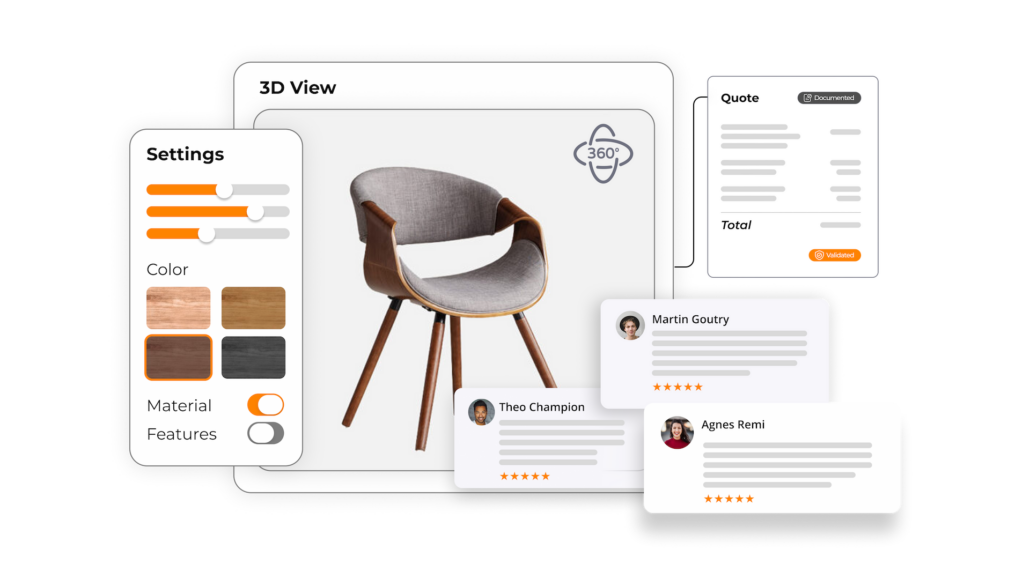
For configurable products, imagery is evidence. Real-time 3D visualization lets customers see selected colors, components, finishes, and dimensions in context. It reduces the gap between what was imagined and what was ordered.
This matters particularly in furniture, sporting goods, fashion, jewelry, mobility, and construction, where appearance and fit affect perceived value. Visual configuration also gives sales teams and dealers a shared reference point instead of asking them to interpret a written specification.
Make pricing and rules visible at the decision point
A visual CPQ process should calculate valid configurations and pricing as selections are made. Customers should not have to wait for a salesperson to confirm whether options work together or what they cost.
That does not mean every price must be public. Complex B2B sales may require contract pricing, approval workflows, or dealer-specific margins. The standard remains the same: the buyer should receive an accurate, timely quote based on the configuration they actually built. Expivi case studies report sales cycles that are 50% faster, demonstrating the value of eliminating manual clarification between buyer, seller, and product expert.
Replace fragmented handoffs with one buying-to-production workflow
A polished storefront cannot build loyalty if the order breaks after checkout. The strongest retention strategy connects the customer-facing experience to operational execution.
| Stage | Traditional complex-product process | Connected configuration workflow |
|---|---|---|
| Product selection | Customers compare PDFs, images, and static option lists. | Customers configure a valid product visually in the sales environment. |
| Quote and approval | Sales teams rekey specifications into CPQ tools or spreadsheets. | Rules, pricing, and configuration data are captured at the source. |
| Order handoff | Teams email files and clarify missing details with production. | Production-ready files and complete order specifications are generated automatically. |
| Customer outcome | Delays and errors can undermine trust after payment. | The delivered product matches the approved configuration more reliably. |
The technical foundation matters. A composable, headless commerce approach allows configuration to operate within your existing integration environment rather than forcing customers into a separate portal. APIs can connect configuration data with PIM, ERP, CMS, eCommerce, and production systems.
For leadership teams, this is not an architecture discussion for its own sake. It determines whether the promise made on the product page survives the handoff to the factory. Expivi has documented a 100% reduction in sales-to-production errors for relevant customer implementations by automating the order specification and production-file handoff. Fewer errors protect margin, but they also protect the trust that earns repeat business.
Which loyalty metrics should complex-product sellers track?
Track the behavior that reveals confidence, not only the final purchase. Repeat purchase rate is essential, but it is a lagging indicator. The operational and experience metrics beneath it show where loyalty is being won or lost.
Use these measures together:
- Configuration completion rate: The share of buyers who begin configuring and reach a valid product or quote.
- Quote turnaround time: The time from a completed configuration to an approved, customer-ready price.
- Order correction rate: How often sales, operations, or production must amend an order after submission.
- Return and remake rate: The cost of customer expectations that were not met by the delivered product.
- Repeat purchase rate by product family: Whether customers return after buying a configurable product, not merely after buying simple accessories.
Segment these metrics by channel. A dealer portal, direct-to-consumer storefront, field-sales application, and B2B account experience may have different friction points. A 40% higher average order value means little if it comes with a rise in returns, rework, or service contacts. Loyalty growth must be profitable and operationally sustainable.
Where should teams start?
Start with the product line where buying friction is most visible and the operational consequences are most expensive. That is often a best-selling configurable range with long quote cycles, frequent sales questions, or recurring production errors.
Map the current journey from initial product discovery through production release. Identify every point where someone re-enters data, sends an email for confirmation, manually checks compatibility, or asks the customer to restate a choice. Those are not minor process gaps. They are moments where confidence drops.
Then establish a baseline. Measure conversion, average order value, quote turnaround, order corrections, returns, and repeat purchases before introducing a new configuration workflow. This lets teams prove commercial impact instead of treating customer experience as an unmeasured design initiative. For organizations assessing a unified 3D configuration, visual CPQ, and design-to-print workflow, a 15-minute Expivi discovery call can help identify the highest-value starting point.
Frequently Asked Questions about increasing customer loyalty
What is the best way to increase customer loyalty for configurable products?
The best approach is to make the product, price, and fulfillment outcome easy to trust. Customers should be able to see their chosen configuration, understand which options are valid, and receive an accurate price without repeated clarification. Loyalty programs can encourage return purchases, but they do not solve uncertainty around fit, compatibility, or delivery. For complex products, a reliable buying and production workflow is the stronger retention foundation.
Does 3D product configuration improve customer retention?
It can improve retention when visualization closes the gap between customer expectations and the delivered product. Seeing colors, materials, components, and options in real time gives buyers more confidence before purchase. It is especially valuable where product appearance, technical compatibility, or dimensions affect the decision. The limitation is data quality: a 3D experience must reflect real product rules and available options, or it can create the very disappointment it is intended to prevent.
How does CPQ help build customer loyalty?
CPQ helps by giving customers and sales teams accurate, consistent answers about what can be sold and at what price. A visual CPQ workflow applies configuration rules as choices are made, preventing invalid combinations from progressing to a quote or order. Faster, more dependable quoting reduces buyer effort and avoids the frustration of price changes later in the process. In B2B sales, that reliability can be as valuable as a discount.
Why do configuration errors cause customers to leave?
Configuration errors break a direct promise. The customer approved one set of specifications, then receives a different product, a delayed delivery, or a request to pay more because an option was incompatible. Even when the business resolves the problem, the customer has spent time and effort correcting an issue they did not create. Automated validation and sales-to-production handoffs reduce the likelihood that those errors reach the customer.
Can headless commerce support a better customer experience?
Yes, when it lets the business add configuration capability without replacing the storefront or forcing customers into a separate system. A headless, API-first setup can connect a configurator with existing commerce platforms, PIM data, ERP records, and production systems. The buyer experiences one consistent journey, while internal teams work with connected data. The key requirement is governance: product rules, prices, and source data must remain accurate across every connected system.
Customer loyalty grows when buyers can make a complex decision once, with confidence, and receive exactly what they approved.