
A quote that needs spreadsheet checks, engineering emails, and manual rekeying is not a sales asset. It is a margin and delivery risk. Manufacturer quote software gives teams a controlled way to configure complex products, apply the right commercial rules, and pass an accurate order specification into production. Across more than 40 published Expivi case studies, customers report sales cycles that are 50% faster and a 100% reduction in sales-to-production errors.
Why does manufacturer quote software need product logic?
It needs product logic because a price alone does not define a manufacturable order. For furniture, construction products, sporting goods, workwear, and made-to-order equipment, a buyer’s selections affect materials, dimensions, lead times, compatibility, and production files.
A conventional quoting tool can calculate a discount, but it often does not know whether a finish is available for a selected frame, whether a component requires a specific mounting option, or whether a custom graphic needs a print-ready file. Those checks remain with experienced sales or engineering staff. The result is slow quoting and inconsistent order quality.
Manufacturer quote software should treat the quote as a governed configuration, not a document assembled after the fact. It should enforce the rules that determine what can be sold and how it should be made. That directly supports the business results documented across Expivi deployments: a 30% increase in conversion rate and a 40% increase in average order value.
For senior leaders, the practical distinction is clear: the system must protect commercial and operational decisions at the same time. A visually attractive quote without production data still creates downstream work.
What should a manufacturing quote include?
A complete manufacturing quote should include every decision required to price, approve, sell, and produce the product. It must be useful to the customer, sales team, finance team, and factory without forcing each group to reconstruct the order.
At minimum, the quote should carry the configured product structure, selected options, customer-specific pricing, quantity, discounts, lead-time implications, approvals, and the production specification. For visual products, it should also preserve the approved rendering or artwork reference. This matters because a 100% reduction in sales-to-production errors is only possible when the order data moves forward intact rather than being re-entered.
The strongest workflows also make commercial rules visible. A sales representative should know when a requested combination is invalid, when a special price requires approval, and when a customer-specific agreement applies before the quote is sent.
Key controls include:
- Compatibility rules that prevent impossible component combinations.
- Dynamic pricing tied to dimensions, materials, quantities, and selected options.
- Approval thresholds for margin-sensitive discounts or nonstandard configurations.
- A production-ready order record that carries the final configuration into ERP and manufacturing systems.
How does configured quoting compare with traditional quoting?
Configured quoting replaces interpretation with controlled data. The difference is not merely a faster PDF. It is whether the organization can use the same approved configuration across sales, eCommerce, operations, and production.
| Process area | Traditional manufacturer quote process | Configured quote process |
|---|---|---|
| Product selection | Sales teams interpret catalogs, spreadsheets, and engineering guidance. | Rules allow only valid options and dependencies. |
| Pricing | Pricing is checked manually across price lists and discount files. | The system applies current pricing and approval logic in real time. |
| Customer experience | Buyers wait for confirmation and may struggle to understand options. | Buyers and sellers see the configured product before approval. |
| Production handoff | Teams rekey order details into ERP or production systems. | The approved specification is transmitted as structured order data. |
| Error control | Errors are discovered during review, production, or delivery. | Invalid combinations are blocked before an order is placed. |
The commercial upside is measurable. In Expivi’s published customer results, faster configuration and guided buying contributed to a 50% faster sales cycle. That outcome is particularly relevant when sales teams manage a high volume of technically variable SKUs or when customers expect self-service ordering.
How should the quoting workflow connect to production?
The workflow should connect the configured customer choice directly to the systems that run the business. A quote that lives in a standalone sales portal creates another handoff, another data copy, and another chance for the specification to change.
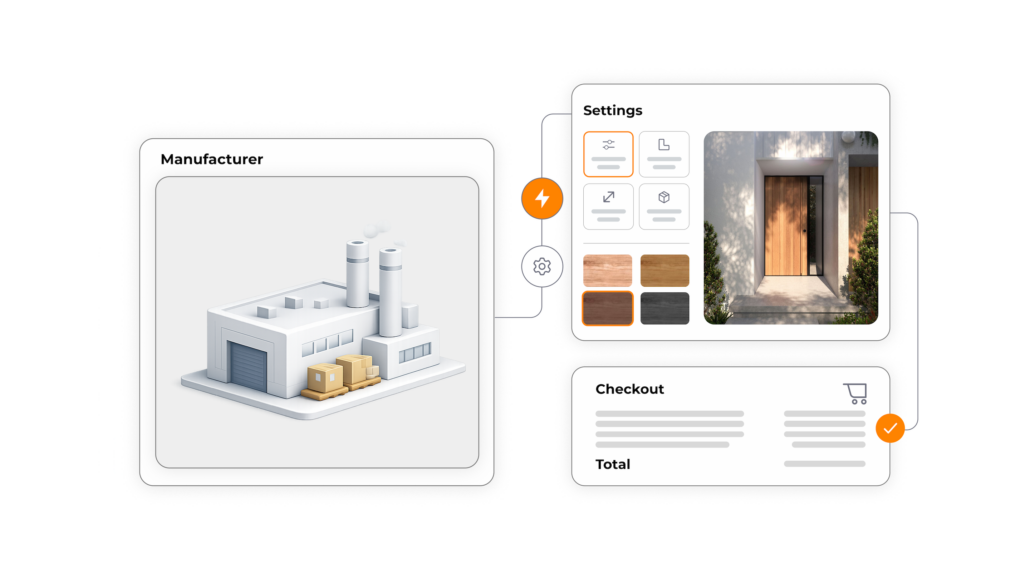
A better architecture embeds configuration and quoting inside the existing webshop or sales environment. That can include Shopify, Magento, SAP Commerce Cloud, Salesforce, or WooCommerce. The configuration engine then exchanges structured data with ERP, PIM, CMS, and production systems through APIs.
Start with the product data model
The product model defines attributes, dependencies, pricing inputs, and outputs. It should be owned jointly by product, commercial, and operational stakeholders. If the model reflects only marketing categories, it will not produce accurate manufacturing data. If it reflects only factory codes, it will be difficult for customers and sellers to use.
A PIM can remain the source for product content, while the configuration layer governs what combinations are available. An ERP can remain the source for operational pricing, inventory signals, and order processing. The quote software coordinates the customer-facing decision and preserves the result.
Generate the right downstream output
For some manufacturers, structured order data is sufficient. For others, the configuration also needs to generate cut files, artwork, technical drawings, or print-ready assets. This is where design-to-print automation changes the economics of customization: approved customer choices become usable production inputs rather than a request for someone to recreate the design.
Expivi is one example of a unified approach that combines 3D configuration, visual CPQ, and production-file automation in an embedded, headless commerce workflow. Its documented case-study portfolio reports a 100% reduction in sales-to-production errors when the completed configuration is passed through without manual handoffs.
Where do manufacturer quote software projects fail?
Most projects fail when organizations buy a quoting interface without defining the decisions it must control. The software may produce faster documents, but it will not improve operational accuracy if product rules, price ownership, and system integration remain unclear.
The first failure point is incomplete product logic. A team may launch with standard options but leave exceptions to email. That can be a reasonable phased approach, provided exceptions are measured and added to the model over time. It becomes a problem when the highest-value or highest-risk orders are always handled outside the system.
The second is treating integrations as a technical afterthought. ERP, PIM, and eCommerce data ownership must be agreed before implementation. Teams need a clear answer to questions such as who owns pricing, how discontinued options are removed, and which system creates the production order.
The third is overlooking the buyer experience. For complex products, visual feedback is not cosmetic. It helps customers recognize what they are buying and gives sales teams a shared reference point. The 30% conversion-rate lift reported in Expivi case studies shows why reducing uncertainty at the point of configuration can have commercial value.
How should leaders evaluate manufacturer quote software?
Evaluate it against revenue control and operational control, not against a generic feature checklist. The right platform should support the selling model you have now while giving the business a path to self-service, dealer ordering, or direct-to-consumer customization.
Ask vendors to demonstrate a real product scenario with dependent options, contract pricing, an invalid selection, an approval rule, and a production handoff. A scripted quote creation demo is not enough. You need to see what happens when the configuration becomes difficult.
Assess these areas in the same evaluation:
- Product-rule management for dimensions, components, materials, and exclusions.
- Visual CPQ capabilities that show the configured outcome and price it accurately.
- Embedded delivery within existing headless commerce and sales environments.
- API-first connections to ERP, PIM, CMS, Shopify, Magento, SAP and salesforce.
- Production outputs that eliminate rekeying and support the actual factory process.
The business case should connect those capabilities to measurable outcomes. If a platform cannot explain how it will reduce quote turnaround, increase order value, or prevent sales-to-production errors, it is unlikely to create the operational change senior stakeholders expect.
Frequently asked questions
What is manufacturer quote software?
Manufacturer quote software is a system that helps sellers configure products, calculate prices, apply commercial rules, and create an accurate quote for complex or customizable goods. The most useful platforms go beyond document generation by validating technical dependencies and preserving the full configuration for downstream systems. This reduces reliance on spreadsheets and manual interpretation. For manufacturers, the real value is an approved order specification that can move into ERP and production without being re-entered.
Is CPQ software the same as manufacturer quote software?
CPQ stands for Configure, Price, Quote, and it is a core capability within manufacturer quote software. However, manufacturing use cases often require more than standard CPQ. The platform may need to manage dimensional pricing, part compatibility, visual product representations, customer-specific contracts, and production outputs. A general CPQ tool can be appropriate for simple product bundles. Manufacturers selling engineered or highly variable products usually need configuration logic that reflects how the product is actually built.
Can quote software integrate with an ERP system?
Yes, quote software can integrate with an ERP system when the implementation defines data ownership clearly. The ERP commonly remains the source for financial, operational, and order-processing data, while the quoting and configuration layer manages valid product choices and the customer-facing experience. Integration should pass the final configuration, commercial terms, and required production details as structured data. This avoids the manual rekeying that creates mismatched order records and delays production release.
Does manufacturer quote software work for eCommerce?
It can work particularly well for eCommerce when buyers need help selecting compatible options, seeing a product before purchase, or receiving a reliable price immediately. Embedded configuration allows the experience to run within an existing Shopify, Magento, SAP Commerce Cloud, Salesforce, or WooCommerce environment rather than sending buyers to a disconnected portal. This supports direct sales, dealer portals, and assisted selling. The key requirement is that online configurations use the same product and pricing rules as internal sales teams.
What should be automated after a quote is approved?
After approval, the system should automatically create the order specification needed by the next operational team. Depending on the product, that can include ERP order data, bills of materials, selected attributes, artwork references, technical documents, or print-ready files. Not every manufacturer needs every output, so automation should match the factory process. The priority is eliminating manual translation between the customer’s approved choice and the instructions used to make, pack, and deliver the product.
The right manufacturer quote software turns complexity into a controlled sales advantage: customers get clarity faster, sales teams protect margin, and production receives the exact order that was approved.